About Kim

Kim was born and grew up in Hokowhitu (Palmerston North) and Wellington. Her first career was in the Merchant Navy, working across the globe on oil tankers, container ships, general cargo ships, and Oil Field and Antarctic Supply vessels; she navigated enough in the Northern Hemisphere, to know that the Southern Cross (Crux Constellation) is the one that points to her home. After 7 years at the Maritime Safety Authority writing legislation and policy and managing maritime Search and Rescue, the lighthouse service, and Maritime Radio, she returned to Hokowhitu. Kim has post-graduate qualifications in Development Studies (MPhil, Massey), Management (Victoria University), and Chaplaincy (Otago), is ordained as a Cherag (light bearer) by the Sufi Ruhaniat; a Universal Sufi lineage with no links to formal religion, whose Holy Book is the Book of Nature; a is a teacher of Ashtanga yoga, and is a Bardic Grade student of the Order of Bards, Ovates, and Druids. For the last fifteen years, Kim has managed Social Service organisations in Palmerston North and is presently Chairperson of Te Pu Harakeke: Community Collective Manawatu, and Palmerston North Girls’ High School. Kim is addicted to books and learning, gazing at the stars, and sitting in awe of the Earth and her biosphere.
As well as offering training and supporting the use of the Pikopikotanga framework, Kim offers Kaitiaki Supervision to Social Service Managers, in person (preferably) or on-line. Please e-mail Kim if you would like to discuss training or Supervision.
About Pikopikotanga
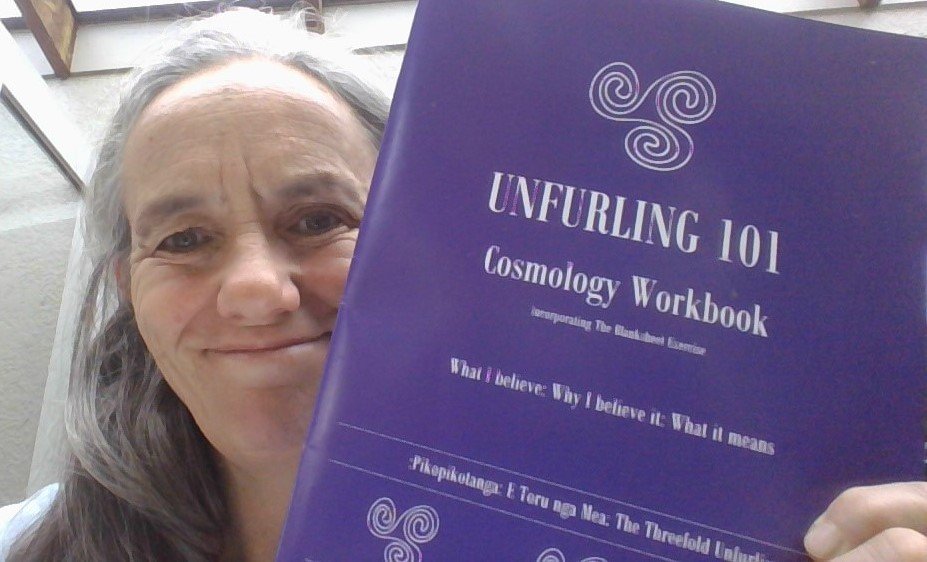
:Pikopikotanga: E Toru Nga Mea: The threefold unfurling: This Kaitiaki framework is a practice to examine and grow, consider and enable, personal and professional authentic expression or Self. Using autoethnography and action research, inspired by a lifetime of curiosity and exploration of what it means to human, and what it means to be alive, and influenced by Dr Rangimarie Turuki Rose Pere’s Celebration of Infinite Wisdom, this model seeks to resonate at a level common to all people regardless of culture and upbringing. Although the model is inspired by the Celtic symbol of the triple spiral or triskele, the spiral is a symbol seen broadly in many (if not all) traditions. Using the triskele symbol the user is invited to consider layers of their lived and inherited experience, beliefs, and expressions, through the lenses of growth, vulnerability, and wisdom. The model has layers for use in personal development and professional needs, and can be used alone or in session with another or a group. The Unfurling 101 Cosmology Workbook is now available free on the resources page, or for $25 (including postage within New Zealand) by contacting Kim.
Background
The driver for this research were two observations; firstly that many people I meet appear disconnected from a sense of the Sacred, and sometimes even have a fear of it, often due to associating the Sacred with organised religion that has scared them or their ancestors; and secondly social service professionals, such as Counsellors and Social Workers, are often motivated to explore Te Ao Wairua[1] with clients, but are uncertain how to do so, having a fixed belief of their own that they think should be suitable for others, or feeling unentitled to enter this space as they don’t consider themselves as having the authority to do so.
The hypothesis underlying this framework is that through roughly 70,000 years of modern human life on this planet, and the hundreds of thousands of years spent evolving to be the sentient upright walking mammals that we are, we had a direct and intimate connection with the wonder of life and our interconnected surroundings. That our brains and bodies evolved and are wired to connect with our surroundings and nature, and our societies initially evolved to tend to these needs. How and why, as our communities got larger and the need for stronger social structures arrived, the connection to the Sacred become intermediated by specialists and dogma[2] was created, is not the scope of this paper. What is fundamental however is that rejecting religion does not need to mean rejecting a connection with feelings of sacredness, and does not need to mean rejection of the wisdom that religious and other spiritual communities have carried through the ages through written, visual, and oral expressions. We do not have to throw the baby out with the bathwater. How can we recreate a healthy connection to the Sacred Realm, and assist our tangata to do so also?
The framework is intended to be used by an individual, in kaitiaki sessions, and in groups as a way to examine and grow, consider and enable, personal and professional authentic expression of Self. While infused with Matauranga Māori this framework does not claim to be Māori and does attempt to be accessible across and between cultures. It uses a framework of Mōhiotanga (exploration of self and verbalising the tacit), Māramatanga (adding knowledge and perspective; illumination), Hōhonutanga (going deeper and gaining clarity), and Mauri Ora (conscious wellbeing and expression of potential), and is infused with wisdom from a lifetime of curiosity about what it means to be human, what it means to be alive, and the exploration of many formal Wisdom traditions.
Biases
“Not all that seems to be true to even the most earnest and sincere investigator’s consciousness is necessarily accurate knowledge. Much that passes for knowledge among human beings is actually, upon closer and more critical inspection, merely prejudice or belief based on distortion, bias, hearsay, speculation, or pure fantasy.” (Murray Stein)
An article such as this is too short a format to fully analyse the foundations from which this framework arises, and therefore a full exploration of potential unintended biased influencing my work. Section 1 of the full article contains a significant exploration of self to offer the reader more insight into my lived and inherited experience that has provided the ground for this framework to emerge. However, I do draw the reader’s attention to two main biases in this framework. Firstly, I believe that all aspects of the Universe, animate and inanimate, are part of a single Divine Unity, and that all life has an authentic fullness that is both our opportunity and our responsibility to express. Secondly, I believe that all life, and especially those in a human body, have an opportunity and a responsibility to help all other life to also express their authentic fullness.
[1] Often with an intention to work with models such as the Te Whāre Tapa Whā approach of Sir Mason Durie.
[2] The Oxford Dictionary defines dogma as “a principle or set of principles laid down by an authority as incontrovertibly true.”